History's Dumpster = GLORIOUS trash! Kitsch, music, fashion, food, history, ephemera, and other memorable and forgotten, famous and infamous pop culture junk and oddities of yesterday and today. Saved from the landfill of time...
Nektar was a German progressive rock band from the late '60s and '70s. And a criminally underrated one. Amongst all the bands of the prog rock genre, I actually like these guys better than Yes. This concept album was their biggest American release in 1973.
I bought this album in the late '90s for a buck at Goodwill. I never heard of Nektar up to that point. But the record was in excellent shape and for a buck, there wasn't much to lose.
In the late 1940s, record sales were great. The Depression and the war had passed and America was entering a new period of comfort and affluence. Just sit back and relax, Truman was going to take care of everything.
But there WAS one little problem......the records themselves.
Recording technology had changed tremendously since Emile Berliner's first gramophone records in the 1890s. We had gone from unresponsive acoustic recording horns and direct to disc master recording to full electrical recording and tape masters.
But very little had changed with the records themselves. They still rotated at 78 RPM, still made of noisy shellac and extremely fragile.
Berliner Gramophone Record, 1897
RCA Victor 78 RPM Record, 1948
In 1948, Columbia Records unveiled the 33 1/3 RPM long playing record. It played for about 20 minutes per side and made of thick and much quieter vinyl.
The first LP Record, 1948
RCA Victor, Columbia's long time rival was also working on a newer and better record at the same time as Columbia. When Columbia came out with the LP record, RCA scrambled on it's own project and in 1949, unveiled the 45 RPM record.
The RCA 7" inch 45 RPM record was cute, VERY small, and RCA's very colourful vinyl (each genre of music had it's own colour of vinyl!) made it an instant hit with younger people. Popular releases were on standard black vinyl. Country releases were on green vinyl, Children's records were on yellow vinyl, Classical releases were on red vinyl, "Race" (or R&B and Gospel) records were on orange vinyl, Blue vinyl/blue label was used for semi-classical instrumental music and blue vinyl/black label for international recordings
Eventually, RCA soon ended it's coloured vinyl lines due to the price of the coloured vinyl compared to the standard black.
It also employed "The World's Fastest Record Changer"
Here's the demonstration record that came with one of these players......
But the 45 RPM record and RCA 45 players DID have a few problems. First, the players could only play 45 RPM records. Nothing else. Second, classical music fans still had to put up with the same mid-movement breaks that plagued symphonic fans since the dawn of classical recording. Something the 33 1/3 RPM record rarely had.
This era in the turn of the '50s was called "The Battle of The Speeds" Some people preferred the 33 1/3 RPM LP, others the new 45 RPM players and old timers who insisted on the 78 RPM speed. The other major labels mostly aligned with the 33 1/3 RPM LP for albums (Capitol however released albums in all three speeds) and 45 and 78 RPM for singles. The 78 RPM single began disappearing in the early '50s and the 78 RPM speed regulated to children's records through hand-me-down phonographs from their parents. The last American commercially released 78 RPM singles appeared in 1959, however they were still made for children's records and older jukeboxes until 1964.
And thus began the era of the 45s. An era that lasted 40 wonderful years. Before the cassette tape, CD and MP3 player, 45s were the perfect portable personal music medium.
Remember these?
And the 45s themselves were super cheap too, less than a dollar each. Fun to collect, share and trade with friends. While some kids had baseball cards and comic books, others had 45s. Portable battery operated phonographs were also made for taking your music anywhere.
Check this little baby out!
And another one.....
And who could forget THESE?
Also known as "spiders"
The very first Stereo 45 RPM record was introduced by Bel Canto Records in June of 1958.
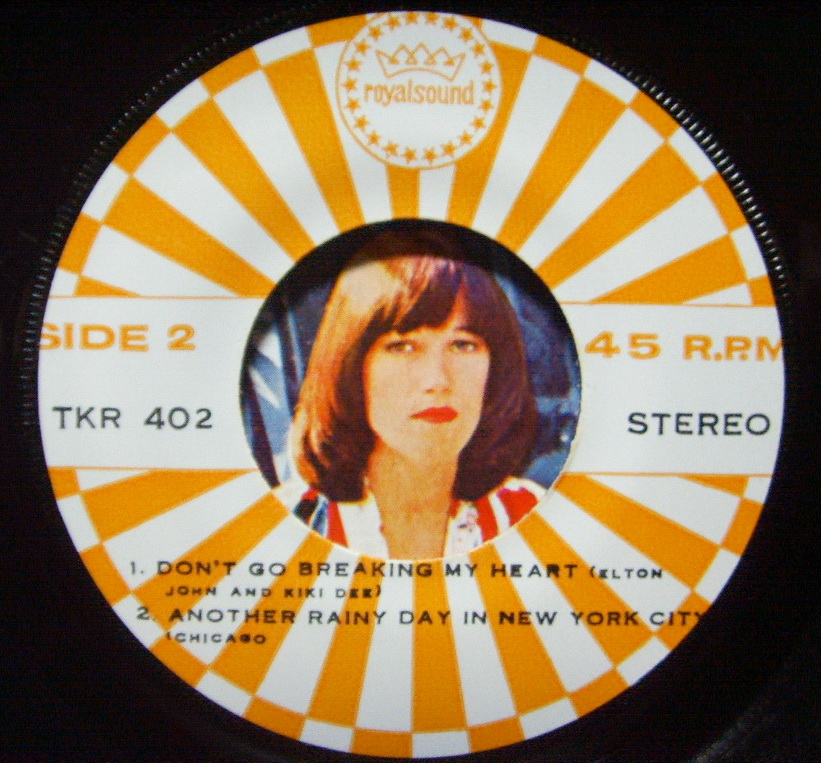
In the UK, Japan and some European countries 45s were pressed with detachable centres. In other European countries, 45s were pressed with a standard 45 spindle hole. The reason there were detachable centres was for compatibility with some foreign record changers (like the early RCA changer, which was extremely popular) and jukeboxes.
US 45
UK 45
Japanese 45
Greek 45
Italian 45
Turkish 45
In Australia, most 45s had standard LP spindle holes.
German 45
Thai 45
Lebonese 45
45s also had the B-side. Most were a second, non-single track from the parent album. But sometimes, it would be a live track, an instrumental version of the A-Side song, an outtake from the parent album session. Or sometimes, a completely original song. Most of the B-sides of Elton John's 45s had songs recorded just for them, as Elton John felt it gave his fans better value for their money. And they did. Most of them are collector's items and many were never released to CD.
There's also been the question of how long can one side of a 45 play. Most 45s run from 2-5 minutes. John Lennon once asked this to George Martin in 1968 and George Martin, after some experimenting, found the answer - 7 minutes, 11 seconds. And thus the playing time of "Hey Jude".
But bear in mind he was also taking into account standard groove width and the automatic record changer, which was very popular in those days. If he went any longer, he risked tripping the automatic changing mechanism of many of these record changers (this record did on many of them regardless.)
(UPDATE: Thanks to John Cerra for reminding me that "Hey Jude" was actually the SECOND longest pop 45 of the '60s and that "MacArthur Park" Richard Harris was actually LONGER than "Hey Jude" by 9 seconds (7:20) and was released earlier than "Hey Jude". My brain isn't what it used to be. - Larry)
However, this wasn't the longest 45 side ever. That distinction belongs to Bruce Springsteen on the B-side of his 1987 single "Fire", a live version of "Incident of 57th Street". It clocked in at just over 10 minutes (10:03)
I'm sure there could have been longer. But I haven't seen any.
(UPDATE 4/30/15 - Wayne Whitehorne says "Longest one I've ever seen is "Lunar Sea" by Camel, Janus J-262 (B side) 10:27. Shortest one I've seen is "Beside" by The Fastest Group Alive, Valiant V-754 (B side) :35". Both have been verified.)
But that's the fun of record collecting. Just when you think you've seen and heard it all.....Surprise!
By the beginning of the '80s, sales of 45s were beginning to gradually slip as sales of cassettes and blank tape began ushering the "mixtape" era. CBS noticed this and test marketed the one sided single. In 1987, A&M released the first cassette single and other record companies quickly followed suit. By 1990 however, record companies began discontinuing the 45, except for jukebox releases and collector's items. However with the vinyl resurrection of the last few years, many companies are back to pressing vinyl.
But there's something about the 45 that an MP3 simply can't mimic. It's REAL. Just the right size. Something you can hold.
And no matter what next big thing comes along, they'll NEVER go out of style.
In the waning edge of the disco craze, a little unknown female duo from Japan called Pink Lady began appearing on American TV.
So WHO were these girls?
Pink Lady was the biggest selling and most famous Japanese pop act of the 1970's. They scored several MASSIVE hits in Japan. And they were ready to hit America
They scored a minor Top 40 hit in America. "Kiss In The Dark" (1979) which peaked at #37. And released an English language album on Elektra Records.
They looked sure become the next BIG thing in America. They took Japan by storm in the '70s. They were very beautiful and very talented. So in March 1980. NBC unveiled "Pink Lady" for your Saturday evening viewing pleasure.
But leave it to American TV network boss minds to completely screw it up.....
You see, Mie (left) and Kei (right) were paired with this dork, Jeff Altman (lower center.) in utterly the WORST variety TV show America has ever seen. This show was so bad, it actually KILLED the variety TV show format in America ever since.
It certainly wasn't Pink Lady themselves. Even the most attractive and talented act couldn't survive a TERRIBLE production.
First, the music on the show was primarily disco at a time when disco was on it's deathbed. Power Pop bands on one end and Adult Contemporary music on the other were dominating the Top 40 charts at the time.
On the first episode of the series (and this is on DVD too. ) He made one particularly shocking comment. Even in that less politically correct year, our jaws dropped
"You just get turned on by my sexy round eyes."
Off in the distance, you could already hear the sound of millions of people changing the channel.
Bizarrely, these girls seemed to take it all in stride. That was because they actually didn't know what was being said. Pink Lady themselves knew very little English. And most of their direction came off-camera and for each sketch, they had to memorize lines they didn't understand.
Finally, this show was aired at prime time on a Saturday night. An AUTOMATIC kiss of death for any new TV show.
In every episode Jeff Altman played the dumbass (very well), flanked by two beautiful Japanese ladies. Pink Lady were the stars of the show. But like a kazoo in the middle of an angelic harp solo, Jeff Altman's annoying presence made it unbearable.
I felt sorry for them. They deserved better. American network TV can be very, very cruel.
Their American show and fame was extremely brief. The show only lasted for ONE MONTH. Only 5 episodes ever aired. And they never attempted an American comeback.
But in spite of this disaster, they did pick up some American fans, who saw through this horrible travesty. They have maintained an English fan site with more information and details on their history, music and current activity (they've reunited every few years....):
They were a disco band at a time when disco was pretty much dead.
Their old label, Casablanca had just been acquired by PolyGram and PolyGram went straight to work dropping all the old disco acts from it's roster, Donna Summer went to Geffen and The Village People signed to RCA. And they revamped to a new wave image.
Out went the costumes, in came
SUPER dorky outfits, makeup and really, really, bad hair.