History's Dumpster = GLORIOUS trash! Kitsch, music, fashion, food, history, ephemera, and other memorable and forgotten, famous and infamous pop culture junk and oddities of yesterday and today. Saved from the landfill of time...
"In 1948, the Yugoslav leader Josip Broz Tito (May 7, 1892 - May 4,
1980) broke up with the Soviet leader Iosif Vissarionovich Stalin (Dec.
21, 1879 - March 5, 1953). Yugoslavia
was suddenly between the two blocks (in the making). Tito's regime
imprisoned many Soviet sympathizers (real or just suspected). Russian
films were not so popular anymore.
Yugoslav authorities had to look somewhere else for film entertainment.
They found a suitable country in Mexico: it was far
away, the chances of Mexican tanks appearing on Yugoslav borders were
slight and, best of all, in Mexican films they always talked about
revolution in the highest terms. How could an average moviegoer know
that it was not the Yugoslav revolution?
Emilio Fernández's Un Día de vida
(1950) became so immensely popular that the old people in the former
republics of Yugoslavia even today regard it as surely one of the most
well known films in the world ever made although in truth it is
probably unknown in every other country, even Mexican web pages don't
mention it much.
The Mexican influence spread to all of the popular culture: fake
Mexican bands were forming and their records still can be found at the
flea markets nowadays."
Ahhh......the long and odd sounding history of the wrongly mastered record....
Nothing
new really. Countless early recordings since the days of the very first
hand wound cylinder recordings have had various pitch and speed
anomalies until the earliest standard was set when electrical recordings
were introduced in 1925, mandating 78.26 RPM as the universal speed for
recordings on disc records in North America from 1925 until the end of the 78 RPM record (slighty less, 77.94 RPM for European recordings.).
And
all was well...for the most part. There are some who beg to differ.
Many Glenn Miller fans had issues with some of his recordings, namely
this classic:
But considering there was only so much recording time on one side of a
78 RPM record, if it sounded a tad rushed, it probably was. Just like
many other 78 RPM direct to disc mastered recordings. But everything
seems to be on the right key here.
However, when tape began to be
used as a standard of mastering albums, an old problem reared it's ugly
head. Some of the earliest tape mastered albums of the '40s had
something called "wow and flutter", very noticeable on analog piano
recordings when the player plays a sustained note. (Play a sustained C
major note on a piano and record it on an average analog tape deck, then
play back the tape and you'll hear the difference.) Technology improved
to reduce that artifact dramatically over the years. But analog tape
still had that problem, no matter how top quality the tape and recording
machine was. But the technology was refined enough on better tape decks
to make it much less noticeable. Digital recording virtually
eliminated that problem, but at the expense of everything else in the
recording. Namely high-hat and cymbals on the early digital recordings.
Tape and record players themselves always had pitch
and speed control problems. Until the '60s when better audiophile
technology came of age and pitch controls were a feature of better made
turntables, there was not much you could do about the problem.
However
in the mastering process of many recordings, either deliberately or by
accident, some tracks in the studio tapes were mastered at the wrong
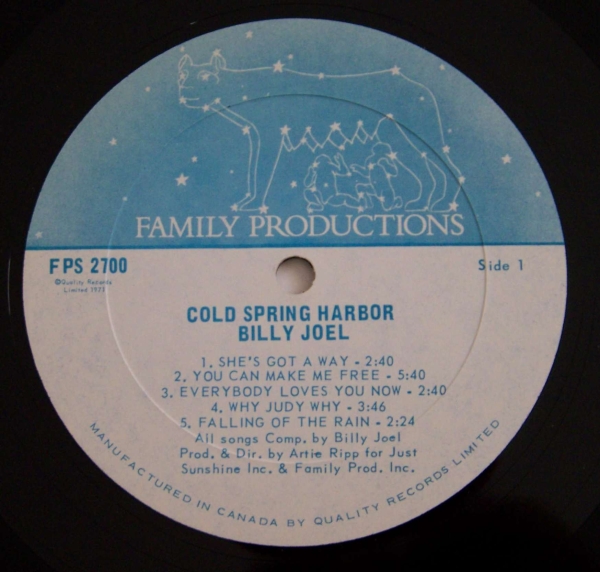
speed. The most infamous example was the original Family Production's
label 1971 release of Billy Joel's Cold Spring Harbor LP.
The instrumental tracks sounded fine, but Joel's voice was speeded up
and sounded far too high pitched. It's been said
Joel himself went around to New England record stores to buy up as many
copies of Cold Spring Harbor as he could (luckily, it never fully
went into national release at the time. But the 1971 release never sold many copies to begin with.) Some of the 1971 originals sold then and they are prized collector's
items today.
The original copies of Billy Joel's Cold Spring Harbor album did not have a Columbia label.
Here is a sample of that original recording (note the pitch difference in Joel's vocals):
It was re-released by Columbia in 1983 with the vocals restored to
normal pitch, but also remixed with slightly different instrumental arrangements
on some tracks.)
But the crux of
this particular biscuit is Robert Johnson's blues recordings of 1936 and
1937, which have been featured on countless compilations. In 1990, Sony
re-released these historic sessions on CD, faithfully remastered from
original acetate master discs.
However recently, it's been discovered that the pitch of the original
recordings may have been exaggerated. When the recordings were slowed
down by 20%, some say they had a more "natural" sound to them than the
more frenzied tempo we are used to hearing Johnson's recordings at. The
sound that many claim started rock 'n roll.
And if that's the
case, how many other classic blues recordings from everybody from Bessie
Smith to Blind Lemon Jefferson are mastered at the wrong speed?
Well
first, being direct to disc, it's hard to deliberately master the disc
at the wrong speed. But on a portable recorder/cutter being battery
powered (likely), as used in those San Antonio and Dallas hotel rooms
when Johnson cut these sessions, it COULD make a slower initial
recording and when the recording was played back at AC powered 78 RPM,
it can sound faster than the actual recording was.
It's debatable amongst blues fans, but it IS a plausible scenario.....read more here
Three dudes and three chicks, they're at somebody's house, sitting SEPARATELY, doing nothing else but listen to the clock tick.
They
are all silent, nobody is busting a move. Detention in Catholic school
isn't this bad. And this is supposed to be a party.
Then one of the guys mentions, almost as an afterthought "Hey y'all, I got a great new album in the mail today"
He puts the needle on the record, the girls begin to smile and everybody begins to dance.
Well,
in spite of the fact that in real life, the girls wouldn't have even
gotten out of the car, let alone put up with guys this lame. I guess it
did sell some records. The selections on this 3 record set looked pretty
good......