History's Dumpster = GLORIOUS trash! Kitsch, music, fashion, food, history, ephemera, and other memorable and forgotten, famous and infamous pop culture junk and oddities of yesterday and today. Saved from the landfill of time...
The Jupiter ACE computer was a British-designed computer that was released in 1982 by Jupiter Cantab, a company founded by two ex-Sinclair Research engineers. One of the unique features of the Jupiter ACE was its use of the Forth programming language, which was considered by many to be ahead of its time.
The Jupiter ACE was based on an 8-bit Zilog Z80A processor running at 3.25 MHz, and had 3.5KB of RAM and 11KB of ROM. It had an audio input/output to a cassette recorder for data storage and retrieval. It could also connect to external floppy disk drives.
Unfortunately, despite its innovative design, the Jupiter ACE was not a commercial success, due in part to a lack of marketing and distribution. The company was eventually acquired by Amstrad, which discontinued production of the Jupiter ACE soon after.
Today, the Jupiter ACE is considered a collector's item by many retro computing enthusiasts. Its use of the Forth programming language and its unique design make it an interesting piece of computing history.
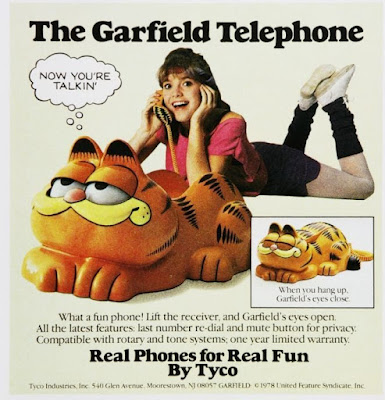
The 1986 Tyco Garfield telephone perhaps would have been another '80s pop culture relic were it not for a phenomena happening to this day halfway around the world.
The phone itself was a conventional working telephone molded as Garfield. It's eyes opened when you lifted the receiver. It was targeted to kids lucky enough to have phone lines in their bedrooms (which was becoming a regular feature in homes in the 1980s.) It was foreign manufactured for Tyco (best known for their model trains and slot racers.)
It even had a toll-free number kids could call and "talk" to Garfield.
And the phone was successful in America, from the numbers of them seen in thrift shops and on eBay.
But they aren't so popular in Iroise, Brittany on the French coast. Because since the 1980s, Garfield phones and parts have been washing up on the beaches of France and for many years, locals didn't know from where until a missing shipping container was found, completely loaded with unpackaged Garfield phones. But since the container is in a sea cave, it's extremely dangerous to access. So it's presumed Garfield phones will keep washing up for many more decades, possibly centuries as the plastic they are made of does not degrade very easily in the elements.
I once saw a mail-order offer for this album in Metal Edge magazine back in 1988. The cover of this made me do the same double take you probably just did. So if you haven't already gotten the trigger warning; This is not an Anne Murray-type album.
But why it was mail order was an interesting fact of music distribution in the 1980s. Some major retail chains back then (including Walmart) simply did not stock then-independent labels such as The Great Kat's then-label, Roadrunner Records. And perhaps partly due to the then ongoing PMRC controversy and Roadrunner's then 1980s line-up of mostly scare-your-overly-religious-parents satanic shock metal bands, such as Obituary, Mercyful Fate and it's frontman, King Diamond that were hugely popular in the headbanger underground of the 1980s.
"And always remember to brush and floss daily, limit sweets, and get a dental check-up twice a year. Mr HappyHorns....AWAAAAAAYYYYY!!!...." Image: Discogs
And in the 1980s, many independent record stores in America outside of larger urban centers were being wiped out by mall chains, such as Sam Goody, Musicland and Wherehouse, which typically only had just enough floor space for the mainstream major label hit albums (though you could special order some releases through some chains, you usually had to pay more.)
So indie labels (even a few majors) often sold direct through fan magazines such as Metal Edge.
Your eyes almost melted from the bright, airbrushed full color glossiness of every page of Metal Edge.
And The Great Kat's Worship Me Or Die! was one ad for a record that somehow stuck in my head. Without even hearing it.
But even in my then heavy metal-centric stomping grounds of Lynnwood, Washington (circa 1988) and even in nearby Seattle, this album was somehow impossible to find locally. In any format.
So while promising myself I'd order a copy Worship Me Or Die! (I mean, like, that cover), other albums distracted me. I was a very foolish mortal. And soon, I would really be in for it.
I almost completely forgot this album until I came across a miracle copy of this LP at a Goodwill a decade later. I grabbed it. Took it home, wiped the dust off the grooves. Put on my headphones. And began my atonement.
And I was instantly disappointed. In myself. For not ordering this record when I should have. Because this album would have been the de facto soundtrack of a lot of headbanger parties, had I heard this back then. Because beneath the layers of metal cheese (and she didn't miss a single cliche) is some of the fastest speed metal guitar fretwork I've ever heard then. Or since.
An institutional grade Cuisinart could not shred speed metal lead guitar like The Great Kat. Forget the lyrics. I kept putting the needle back at the beginning of her guitar solos; What the hell did I just hear?
Even with all the thrash/speed metal I've heard up to this point, I still can't comprehend how this still exists absolutely ignored by the mainstream (ahem, rock radio.) But fortunately, you can hear this lost classic in it's entirely on Spotify and YouTube.
The Great Kat (aka Kathrine Thomas) is a Julliard-trained classical musician, which other than actual demonic influence might explain her amazing fretboard dexterity. She played classical music before crossing over to metal. She plays both violin and guitar.
Her later releases, while not quite as over the top as Worship Me Or Die! combined classical music with speed metal. Her skill getting even more shockingly fast with each new album.
The Great Kat Beethoven on Speed (1990)
And The Great Kat is still showing the boys how it's done. This is her latest, "Shredssissimo" (2021).
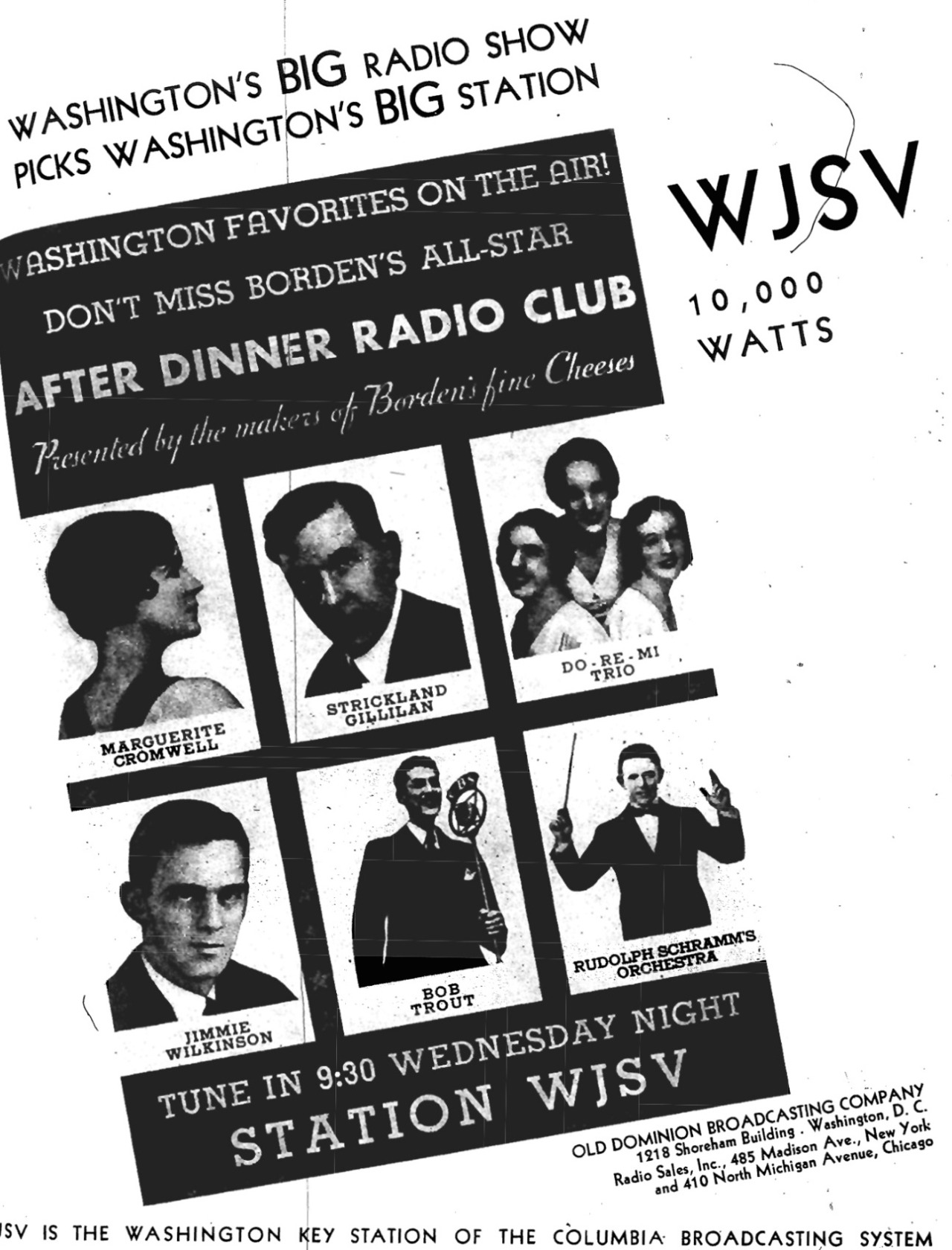
If you were ever curious about how network radio sounded like 82 years ago today, here's your answer.
WJSV 1460 AM was a CBS affiliate radio station that served Washington D.C. It moved to 1500 kHz as part of the 1941 NARBA agreement, where it was later known for many decades as WTOP, an all news station. With WTOP moved to FM, it is known today as WFED federal news radio.
WJSV Studios
In 1939, engineers at WJSV set about recording an entire broadcast day. This was no easy task in 1939. Magnetic tape was unheard of. Wire recording was rare, mostly unheard of until later in the 1940s and prone to breaking and other snafus. So they recorded the output of the radio station on a record cutter on giant transcription discs. These have thankfully survived the decades and serve as an authentic template for old time radio re-creation for any project.
Listening to it, it was clearly another time altogether in America.
In the aftermath of World War II, full time civilian manufacturing resumed. But not at pre-war levels at first. There was a lot of retooling to be done to get the factories, who had switched to making mostly military goods for the war back up to speed. (It’s a leap from live bunker busters back to cute baby blankets.) So in the following days and weeks after VJ Day, manufacturers were quick to tell consumers to be patient as they ramped up civilian production.
The shortages didn’t last long for most and everything was at full speed by mid-1946. However, there was one product that would not wait; Nylon hosiery.
Women standing in line for nylon stockings outside Miller's Department Store in Oak Ridge, TN in January 1946. Image: Wikipedia
Dupont Chemical invented nylon in 1939 as an alternative to silk, Japan had embargoed all silk exports to the United States. So nylon became a not only a replacement, but an affordable one.
When World War II broke out, nylon was used for making parachutes and other military items. Civilian production was nearly ceased.
Silk and nylon stockings which could no longer be worn were being collected in stores throughout the country for conversation into powder bags which propel the projectile in big naval and coast defense guns. Image: U.S. National Archives
So women had to take especially good care of their nylon hose. Wearing them only on special occasions. But runs, sags and holes still laid waste to them all. It had actually gotten to the point where makeup-like products were introduced for women to color their bare legs just to replicate the look of nylon hose.
Woe to the ladies who wore this stuff with white dresses and skirts in public......
There were also actual black markets for nylon stockings.
So when Dupont announced they were resuming full production of nylon stockings in 1945, women across America cheered. But there was a problem.
They announced it too soon. They promised a full production of pairs in the first shipment. The nation had millions of women who wanted to feel nylon on their legs again. Now.
But Dupont could only deliver a small fraction of that due to the actual speed of ramping up production (it couldn't be done overnight.) And that’s when all hell broke loose.
Store managers begged female customers to be patient. Department store windows were smashed in Washington D.C. In Pittsburgh, 40,000 women fought over 13,000 pairs of nylon stockings.
Dupont owned the patent and only when faced with anti-trust suits in 1951, long after the riots were over did Dupont license the manufacture of nylon to competitors.
There's an essence of a woman who buys her dresses with her buckets of KFC (nudge-wink).
Perhaps one of the most questionable products of the 1960s was the disposable paper dress.
And it still looks like instant disaster;Just add rain. Hoses and sprinklers. Sweat. Pets. Perverts. Wind. A wayward snag, tree branch or sticker bush. Hot cigarette/joint ashes. Sparks. And of course, plain old fire. To mention a few.
...and that's before Becky looks at it and turns up her nose... Image: Wikipedia
But the 1960s were of course, a very libertine time in fashion. But even so, somebody had to prove that a disposable evening dress could be both fashionably hip and safe. (Or at least in some mediocre way.) Enter the Scott Paper Company in 1966 with their promo ads in teen magazines.
Right there, you're probably thinking "Uh-oh", as tissue paper is not known for it's durability, no matter what the TV ads say. And assuming the worst, you're probably wondering where the hell Ralph Nader was on this, to say nothing of every parent of a teenage girl.
But these dresses weren't that flimsy. In fact, these dresses could be worn more than once. But still, there were risks involved. Washing them (which you could do on some paper dresses only once) will remove the fire retardant coating. Other paper dresses would disintegrate being washed.
But after a while, sweat stains, odors, wear, small tears and strap failure begin to take their toll.
Hallmark Cards really got into the act and made several styles of paper dresses.
But they were primarily a commercial avenue. Whether it's the Yellow Pages, Johnston's pies or The Chicago Sun-Times.
Hmmm...Not really knowledgeable about diamel, Rd. But when you mentioned the Doxidan Cowboy, you hit solid gold.
Everybody sing!:
When I’m irregular Here’s what I do I take Doxidan because it works When I expect it to Doxidan, gentle Doxidan, I get no surprises I feel better in the morning Sure as the sun rises Doxidan, Doxidan When nature needs a helpin’ hand Get overnight relief with Doxidan As sure as the sun rises.
The Doxidan Cowboy was a 30 second TV spot, circa 1987. And from the YouTube comments on this commercial, I'm starting to think if Doxidan's parent company had released this as a promo 45/cassette single with each package of Doxidan, it might have been played at weddings.
He's not quite George Strait. More like Don Williams in a porn 'stache. As smooth as, well, the effect of this product. But really, this should've won the CMA award that year.
Tragically, the Doxidan Cowboy remains anonymous. So it's unknown if he made any recordings of this jingle. Or has any albums. But here at History's Dumpster, he'll always be our Roy Rogers.
The Dick Tracy Wrist Radio was a crystal radio, powered by nothing by AM radio waves, an aerial and grounding wire connected to a grounded piece of metal (like a radiator pipe.) And a kid's imagination.
You could even talk to a friend with the radio by connecting the aerial wires to your friend's Dick Tracy wrist radio. And it worked primarily because you were in actual speaking distance from your friend.
It wasn't very loud. In fact, it was hardly audible and you had to have your ear right against it to hear it. And even then, it only picked up the strongest local AM radio broadcast signals (in spite of this ad copy hype, crystal radios have no superheterodyne tuning, which made AM radio signals squeal, distort and drift.)
$3.98 sounds like a average price for a disposable piece of junk (unless you were a hardcore Dick Tracy fan. And how dare I call it 'junk'.) But bear in mind $3.98 in 1947 had the same purchasing power as $48.21 in 2021. To put into perspective, most parents had better things to do with that kind of money. Besides, they knew you could put together an even better working crystal radio for much, much less than that and even from parts already around the house (many built radios for themselves and their families in the Depression, as many kids did since money for new radios was so scarce, it was cheaper for mom and dad to just learn the science and do it themselves.)
A battery powered transistorized version later came on the market in 1958 (hopefully better working.)
Long derided by snooty food critics entirely too old to be eating in school cafeterias anyway, The classic American Public School Pizza is a beloved treat of generations of American elementary school kids.
In fact, I looked forward to pizza day so much, by second grade, I began devising new ways of getting extra slices. Flattery and fresh picked flowers for the lunch ladies worked. At the expense of my reputation with my classmates. But I'm not the kind to burp and tell.
But this rectangular treat has all but vanished from many modern school lunchroom menus. Replaced by bland, "healthy" foods.
The recipe had been preserved on schoolpizzarecipe.com, but this site has been offline. However, I got the recipe off Internet Archive and here it is for your drooling pleasure.
Crust:
2 ⅔ flour
¾ cup powdered milk
2 T sugar
1 packet of quick rise yeast
1 tsp salt
1 ⅔ cup warm water (105-110 degrees)
2 T vegetable oil
Filling:
½ pound ground chuck
½ tsp salt
½ tsp pepper
1 8oz block mozzarella cheese – grated yourself (To be authentic school pizza, you will have to use imitation mozzarella shreds.)
Sauce (Make sauce the day before):
6oz can tomato paste
1 cup water
⅓ olive oil
2 cloves garlic minced
1 tsp salt
1 tsp pepper
½ tbsp dried oregano
½ tbsp dried basil
½ tsp dried rosemary crushed
Crust:
Preheat oven to 475 degrees. Spray pan with Pam and lay Parchment paper down (Pam makes it stick)
In a large bowl – flour, powdered milk, sugar, yeast, salt – whisk to blend
Add oil to hot water (110-115 degrees) – pour into your mixture
Stir with a wooden spoon until batter forms – don’t worry about lumps – you just want no dry spots
Spread dough into pan using fingertips until it’s even. If dough doesn’t want to cooperate, let rest 5 minutes and try again
Bake just the crust for 8-10 minutes – remove from oven and set aside.
Brown meat until it resembles crumbles – set aside and drain meat
Get out the pizza sauce – to partially baked crust, assemble:
Sauce – spread all over crust
Sprinkle meats
Sprinkle cheese
Bake at 475 degrees for 8-10 minutes until cheese melts and begins to brown
Remove from oven – let stand 5 minutes
Cut in slices and serve.
Some of you may opt for gluten-free flour and real cheese, but that's missing the beauty of school lunch pizza, it's supposed to be a sinful treat.